According to Sushruta, who was an ancient Ayurvedic Indian physician, health is defined as:
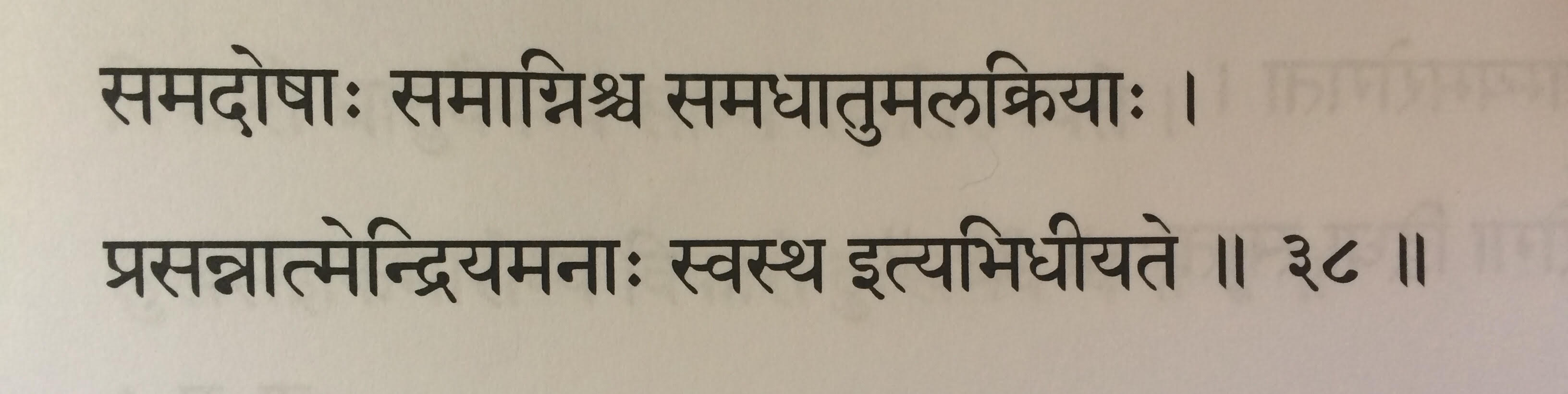
“The one who is established in self, who has balanced doshas, balanced agni, properly formed dhatus, proper elimination of malas, properly functioning bodily processes, and whose mind, soul and senses are quiet and content is called a healthy person.“
Ayurveda literally means the science of life. It is an ancient healing science that originated in India over 5000 years ago. To be extremely basic, Ayurveda teaches us how to correct disturbances in the body through eating a seasonal diet, performing cleansing and rejuvenation treatments, getting exercise and practicing mindfulness all appropriate for your individual constitution.
The body and mind are controlled by the Doshas aka Vata, Pitta and Kapha. The Doshas are made up of the elements of Ether, Air, Fire, Water and Earth. Vata is the combination of Ether and Air which is the energy of movement. Pitta is the combination of Fire and Water which are important for digestion and metabolism. Kapha is Water and Earth, which give the body stability and strength.
Agni is our digestive fire to transform both food and information into energy. If we are lacking in appetite or feel that we are mentally cloudy, we need to work on our Agni through the use of herbs, the type of food that we eat and breathing exercises.
Dhatus are the tissues of the body and relate to plasma / lymph, red blood cells, muscle tissue, adipose tissue, bones, bone marrow, nervous tissue, connective tissue, reproductive tissue. The tissues of the body are created from the foods we eat. We have the ability to create healthy or weak tissue depending on the foods we eat and our mental state while eating. Poor quality food will create deficient tissue which is more likely to create a defective space within the body for disease to move in.
Malas are the waste products of the body – feces, urine and sweat
To maintain or correct health, daily routines known as Dinacharya (deena-char-e-ah) and seasonal routines known as Ritucharya (rit-u-char-e-ah) should be performed to both the body and the mind. Daily routines include proper rest, eating seasonally, performing exercise, and practicing mindfulness.
From a western perspective, if we are not presenting symptoms of illness, we are healthy. There is no consideration of the state of the mind – is it calm? Or emotional state – is the person truly happy and content?
Eating healthy foods and not exercising, or living in a destructive environment can also lead to disease.
Take time to reconnect to your body ~ mind ~ spirit to ensure that you are both physically and mentally healthy.
 Vibrant Health by Brenda Bodnar